20 Oz Skinny Tumbler Santa Claus Wrap: A Stitcher's Review
Last week a client walked into my studio holding a sleek 20oz skinny tumbler and asked if I could create something with real holiday warmth. She wanted embroidered accessories to match the tumbler design she had just ordered. I pulled up the 20 Oz Skinny Tumbler Santa Claus Wrap on my screen, and right away I knew this would spark an interesting conversation about how a graphic template can inspire stitched work. This is the kind of design asset that makes you think beyond its original purpose.
Let me walk through what I see, what I would actually do with this design in an embroidery workflow, and where it fits into a small creative business. I am not here to give you a basic product description. I want to share how this artwork behaves when you start imagining thread, fabric, and finished products that real customers will hold in their hands.
First Impression: The Mood Behind the Santa Wrap
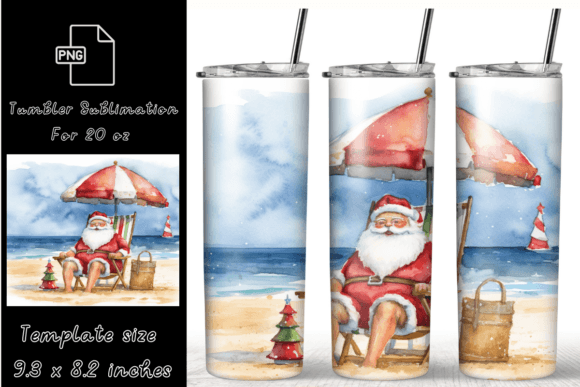
Opening the high-resolution PNG file, the first thing that hits me is the classic Christmas personality. The 20 Oz Skinny Tumbler Santa Claus Wrap carries a traditional Santa theme with a layout shaped specifically for a tall, slender tumbler. The template size sits at 9.3 by 8.2 inches, which is generous. For anyone working with sublimation, that is a ready-to-press full wrap. For an embroidery designer like me, it is a strong compositional reference. The proportions feel balanced, and the vertical flow of the artwork naturally guides the eye along the tumbler body.
I immediately picture this Santa motif translated onto a tote bag side panel or the back of a denim jacket. The mood is festive without being overly cartoonish. There is a certain warmth in the way the elements are arranged. This is not a flat, lifeless clip art piece. It has enough visual personality to hold its own on a handmade product. When I evaluate any design for embroidery potential, I ask whether the artwork can trigger an emotional response from a buyer. This one does. A customer scrolling through Etsy listings or browsing a craft fair table would pause on this Santa. That is half the battle won.
Sizing and Layout: What the Template Tells an Embroiderer
The stated dimensions of 9.3 by 8.2 inches are interesting from an embroidery perspective. Most home embroidery machines max out around 8 by 12 inches or 8 by 14 inches for a multi-needle setup. A single-needle machine often caps at 5 by 7 inches or 6 by 10 inches. This means the full wrap artwork, as designed, would need resizing or splitting for many embroidery hoop sizes. I would scale it down considerably for a sweatshirt chest placement or a tote bag front. At roughly 60 to 70 percent of the original size, the design becomes much more manageable for standard hoops while keeping the detail readable.
The ZIP file includes both straight and tapered PNG versions. That is a thoughtful touch for tumbler sublimation, and it also gives me a clearer sense of how the artwork adapts to different surfaces. For embroidery, the tapered version hints at how the design might curve around a cap or follow the contour of a baby bib. I appreciate when a Graphics asset provides multiple layout options. It shows the creator considered real-world application, not just a flat screen view.
Where This Santa Design Would Shine in Embroidery
I mentally run through my product catalog every time I review a new design asset. Here is where the 20 Oz Skinny Tumbler Santa Claus Wrap would make the most sense stitched out:
- Holiday tote bags: A scaled version on natural canvas with rich red and white thread would look professional and giftable.
- Sweatshirt embroidery: Placed on the upper back or chest of a crewneck, this Santa motif adds boutique-level appeal.
- Kitchen towels and aprons: The festive theme pairs perfectly with hostess gifts and seasonal home décor.
- Pillow covers: A larger stitch-out on a linen or cotton blend pillow cover creates a cozy holiday accent.
- Embroidered patches: Select portions of the artwork could be isolated and turned into standalone patches for jackets or caps.
- Baby and toddler apparel: A simplified, softened version on a baby romper or bib would sell well in small shops during November and December.
In each of these cases, the design's recognizability works in its favor. Santa is Santa. Customers do not need to decode an abstract pattern. They see the familiar figure and immediately connect it to holiday gifting, family traditions, and seasonal cheer. That instant recognition is valuable for a craft business or Etsy seller who needs products that sell themselves visually.
Thread, Texture, and the Realities of Stitch Conversion
This is where I have to be honest about the gap between a Graphic Templates asset and a finished embroidery piece. The PNG files are raster images. They are not digitized embroidery files. No stitch types, no thread color assignments, no underlay settings. If you want to stitch this design, you will need to either digitize it yourself or hire a professional digitizer. The artwork quality is high enough to serve as excellent source material. The lines are clean, the color separation is implied, and the shapes are distinct enough for a digitizer to map out satin stitch borders, fill stitch areas, and running stitch details without guesswork.
I would recommend a thoughtful thread palette. Deep crimson for the Santa suit, bright white for the beard and fur trim, a touch of gold or metallic thread for buckle details, and a soft skin tone for the face. Metallic thread adds a premium feel but requires slower machine speeds and a quality stabilizer. On dark fabrics, you will need to consider a white underlay or a light-colored base layer to make the red and white threads pop. I always test on both black and natural fabric scraps before committing to a final product. The contrast differences can surprise you.
The Tricky Parts: What Needs Extra Attention
Every design has sensitive areas, and the 20 Oz Skinny Tumbler Santa Claus Wrap is no exception. The Santa face details, like eyes and beard texture, require careful stitch density management. Too dense, and the fabric puckers. Too light, and the facial features lose definition. I would run a test stitch on a medium-weight cotton with a cutaway stabilizer and inspect the small details under good lighting. If the beard has fine lines or wispy shapes, those might need to be simplified or reinforced in the digitizing stage.
Stretchy fabrics like jersey knits or performance wear add another layer of complexity. A Santa design with large filled areas can distort if the fabric shifts during stitching. A fusible mesh stabilizer and proper hooping technique become non-negotiable. For caps and curved surfaces, the tapered version of the template gives a helpful preview, but the actual stitch file will need to be adjusted for the cap frame and curvature. I would not try to stitch the full 9.3-inch width on a cap. A focused section of the design, perhaps just the Santa face and hat, would work much better on a structured baseball cap front.
From a Business Angle: Will It Sell?
I think about customer perception constantly. When someone receives a handmade item with this Santa design, what do they feel? The answer shapes whether I would use the 20 Oz Skinny Tumbler Santa Claus Wrap in my product line. The design has a timeless quality. It does not rely on trendy fonts or obscure references that will fade by next season. A well-executed embroidered version of this Santa on a quality tote bag or sweatshirt would command a fair price at a holiday market. The familiarity of Santa combined with the craftsmanship of embroidery creates a value proposition that customers understand and trust.
For small shop owners and creative entrepreneurs, consistency matters. Using a design that photographs well and looks professional in listing images builds buyer confidence. I would stage finished products with warm lighting, natural textures, and perhaps a coordinating tumbler to tie the story together. The design lends itself to cohesive branding across multiple product types. A pillow cover, a tea towel, and a tote bag all featuring the same Santa motif create a collection feel that encourages multiple purchases.
Practical Notes Before You Start Stitching
I keep a mental checklist for every design I evaluate. Here is what I would recommend for anyone considering this artwork for an embroidery project:
- Digitize thoughtfully: The PNG is excellent source material, but the stitch file needs professional attention. Do not expect to auto-digitize and get clean results.
- Test on scrap fabric first: Run a full stitch-out on fabric similar to your final product. Check for puckering, thread breaks, and registration issues.
- Check thread color contrast: What looks good on screen may look muddy in thread. Hold physical thread spools against your fabric under natural light.
- Confirm your hoop size: The full template is 9.3 by 8.2 inches. Scale down as needed for your machine's maximum stitch area.
- Inspect small details: Pay close attention to facial features, beard texture, and any fine lines that might close up during stitching.
- Test on light and dark backgrounds: The same stitch file can read very differently on white canvas versus black denim.
- Use proper stabilizer: Cutaway for knits, tear-away for wovens, and always match the stabilizer weight to the stitch density.
- Verify licensing before selling: As a Graphic Templates product, the usage rights for finished physical items or digital embroidery files should be confirmed with the original seller.
Rethinking the Template Beyond Tumbler Sublimation
What I appreciate most about the 20 Oz Skinny Tumbler Santa Claus Wrap is how it invites creative reinterpretation. The fact that it comes from a Graphics category does not limit its usefulness to sublimation alone. I have used similar templates as underlays for applique design work, as reference images for custom digitizing, and as visual placeholders in printable mockups for client approvals. The high-resolution quality means you can zoom in, trace clean lines, and make confident design decisions without pixelation getting in the way.
For a digital product seller or someone building a design assets library, this Santa wrap holds its weight. The straight and tapered versions cover both common tumbler shapes, and the generous dimensions give you room to crop, rotate, or extract elements as needed. I could see pulling just the Santa belt buckle detail and turning it into a small embroidered accent on a wine bag or a stocking cuff. The modular potential is there if you are willing to experiment.
Final Thoughts from the Stitching Table
After spending real time analyzing the 20 Oz Skinny Tumbler Santa Claus Wrap, I can say this is a solid graphic asset with genuine cross-discipline potential. It is not an embroidery file, and I want to be clear about that. But for an embroiderer who knows how to digitize or who works with a skilled digitizer, the artwork provides a strong foundation. The Santa theme is evergreen, the layout is well-proportioned, and the visual appeal translates effectively to fabric and thread.
If you are a machine embroidery design enthusiast looking for your next holiday project, or a small business owner planning seasonal inventory, this template deserves a close look. Treat it as creative fuel. Test it, adapt it, and stitch it into something that makes your customers smile. That is always the real test of any design asset worth keeping in your collection.